
راهنمای مجموعهداران · 3 min read
Reading a Seljuq Qur’an folio: ornamental Kufic, illumination and page evidence
CraftPersia editorial draft · specialist review pending · بهروزرسانی 2026-10-12
این راهنما هنوز به فارسی ترجمه نشده است و فعلاً به انگلیسی نمایش داده میشود.
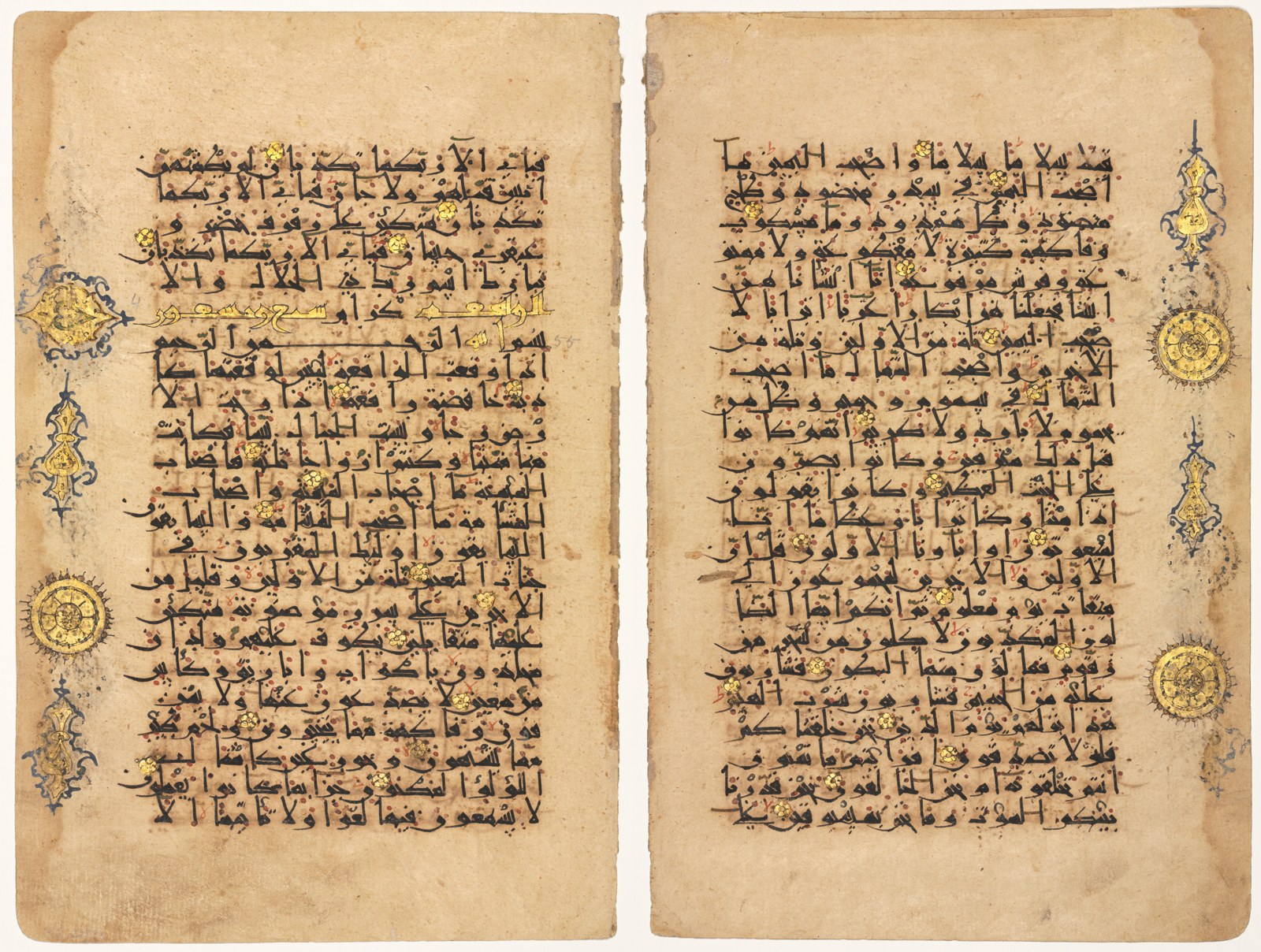
1100s · CP-LIB-CMA-1933-488 · consulted 2026-10-12 · Cleveland Museum of Art · CC0 (museum open access; resized JPEG) · منبع عکس ↗
A Seljuq-period folio with two recorded faces
Cleveland Museum of Art records accession 1933.488 as a folio from a Qur’an, made in Iran in the 1100s, within the Seljuq period. Its medium is ink, gold and colours on paper, and its sheet measurements are 30.6 by 20 centimetres. The downloaded image presents both faces together; it should not be mistaken for an open bound manuscript photographed in situ.
A folio is a leaf with two faces. The catalogue includes inscriptions and script information for the surviving text. Consult those records when discussing contents rather than guessing words from decorative appearance. An isolated leaf does not establish the size, binding or complete text sequence of the original manuscript.
Text area, ornament and the page hierarchy
Dark writing fills the text area while gold and coloured ornament marks divisions and the margins. Read these spatial relationships before naming every ornament. The museum describes the script as Eastern Kufi and discusses East Persian ornamental Kufic. This is a sourced script description, not an identification inferred merely from angular-looking strokes.
The page brings writing and illumination into a coordinated layout. That does not mean one person executed all its parts. Copying, ornament, material preparation and later mounting could involve different hands and dates. A library caption should distinguish the textual object, the decorated surface and the photograph rather than treating all as one authorial event.
- Distinguish the text block from marginal ornaments.
- Use the catalogue’s script description rather than a visual guess.
- Record both faces and do not crop away edge evidence.
Transcription, translation and attribution are separate tasks
A transcription records written words; a translation renders their meaning in another language; an attribution assigns a maker, date or place. Completing one does not automatically accomplish the others. The catalogue records Qur’anic passages and line information, but a reader should follow its face-specific entries instead of treating a decorative title as the text itself.
Dates, ownership marks and marginal additions require their own reading. Do not turn an uncertain letter group into a named calligrapher. If several scholarly readings differ, preserve the disagreement with citations. The script family can help organise comparisons without proving an exact workshop or individual hand.
Paper, colour and gold without destructive testing
The catalogue medium identifies paper, ink, gold and colours. A photograph cannot determine paper fibre, binder or the application method of every golden area. Shell gold and gold leaf are distinct material practices, but reflectivity alone is not enough to identify them. Likewise, discolouration can have several causes and is not a reliable age test.
Do not rub gold, wet ink, flatten a leaf under improvised weights or lift it by one corner. Published photographs allow reading without repeatedly handling the object. A conservator can assess support, framing and light exposure for a particular leaf, especially where inks or pigments are unstable. Historical manuscript fragments should not be rearranged to create a more attractive decorative panel.
An ethical manuscript research record
The museum records acquisition and provenance separately from the medieval date. Preserve that distinction. Lawful collecting requires more than admiration for calligraphy: ask how a leaf entered the market, whether it was recently detached and what ownership or export documentation accompanies it. A photographed museum folio does not legitimise another undocumented leaf.
For contemporary Iranian calligraphy and illumination, record the artist, support, materials and date as new work. Do not describe copies of historical pages as original medieval objects. In this library the folio is a historical reference, not a sale item, and its open-access photograph does not certify another sheet’s authenticity or condition.
- Collection
- Cleveland Museum of Art
- Accession
- 1933.488
- Catalogue date
- 1100s
- Origin as catalogued
- Iran
Keep the evidence layers separate
A useful research record distinguishes direct observation, the institution’s catalogue statements and your own interpretation. None of these should silently replace the others. Record the source and access date before comparing a historical object with a current listing.
- Observe: shape, layout and visible features.
- Attribute: retain the catalogue’s exact qualifications.
- Investigate: seek additional views, condition information and lawful provenance.
| Evidence | Documented statement | What it does not establish |
|---|---|---|
| Identity | Folio from a Qur'an · 1933.488 | Identity or authenticity of another object |
| Date | 1100s | An independent date for a similar listing |
| Material | ink, gold, and colors on paper | A complete technical analysis from the photograph |
| Origin | Iran | Provenance of contemporary goods with similar ornament |
| Photo licence | CC0 (museum open access; resized JPEG) | Rights to unrelated auction or shop photographs |
منابع و مطالعات بیشتر
- [1] Cleveland Museum of Art: Folio from a Qur'an, 1933.488 ↗Primary catalogue source; consulted 12 October 2026. Qualifiers and collection updates take precedence over this editorial reading.
- [2] Canadian Conservation Institute: Caring for cultural heritage ↗Preventive conservation context, not a treatment prescription.
این منابع زمینهٔ پژوهشی فراهم میکنند، نه تأیید اصالت یا پیشینهٔ یک شیء خاص. تفسیرهای سردبیری همچنان در دست بررسیاند.